A warehouse floor carries forklifts, pallet trucks, racking loads and constant foot traffic. Unprotected concrete soon starts dusting, cracking and wearing at joints, which damages goods, slows operations and increases maintenance. A warehouse floor coating protects the slab and keeps the facility clean, bright and safe.
Problems With Uncoated Warehouse Floors
- Concrete dust settling on stored goods and packaging
- Surface wear in forklift lanes and loading bays
- Oil, fuel and chemical stains that are hard to clean
- Faded or missing aisle and safety markings
- Damaged joints and edges that affect forklift wheels
Which Coating Is Right for Your Warehouse?
Epoxy Floor Coating
For general warehouses and distribution centres, a self-leveling epoxy such as Dupoxy SL gives a hard, seamless and dust-free surface with good abrasion resistance. It is easy to clean and allows clear colour-coded marking. See our epoxy flooring systems.
PU Concrete Flooring
Cold stores, food warehouses and areas with washdowns or temperature changes are better served by PU concrete such as Ducrete MF, which tolerates moisture and thermal shock. Learn more about PU flooring.
Polyaspartic Coating
Where the warehouse must return to service quickly, a fast-curing polyaspartic coating can reduce downtime.
ESD Flooring
Warehouses storing electronic components may need ESD (anti-static) flooring.
Key Points for a Long-Lasting Warehouse Floor
- Surface preparation: grinding or shot blasting is essential for proper bonding.
- Joint and crack repair: repair before coating to protect edges from forklift impact.
- Correct thickness: heavy traffic lanes need a thicker, more durable system.
- Line marking: plan aisles, pedestrian walkways and loading zones before application.
- Phased work: large warehouses can be coated section by section to keep operations running.
Cost of Warehouse Floor Coating in Bangladesh
Cost depends on the system, thickness, slab condition and area. See our epoxy flooring price guide and PU concrete price guide for per square foot ranges.
A Real Example: Factory Warehouse Floor
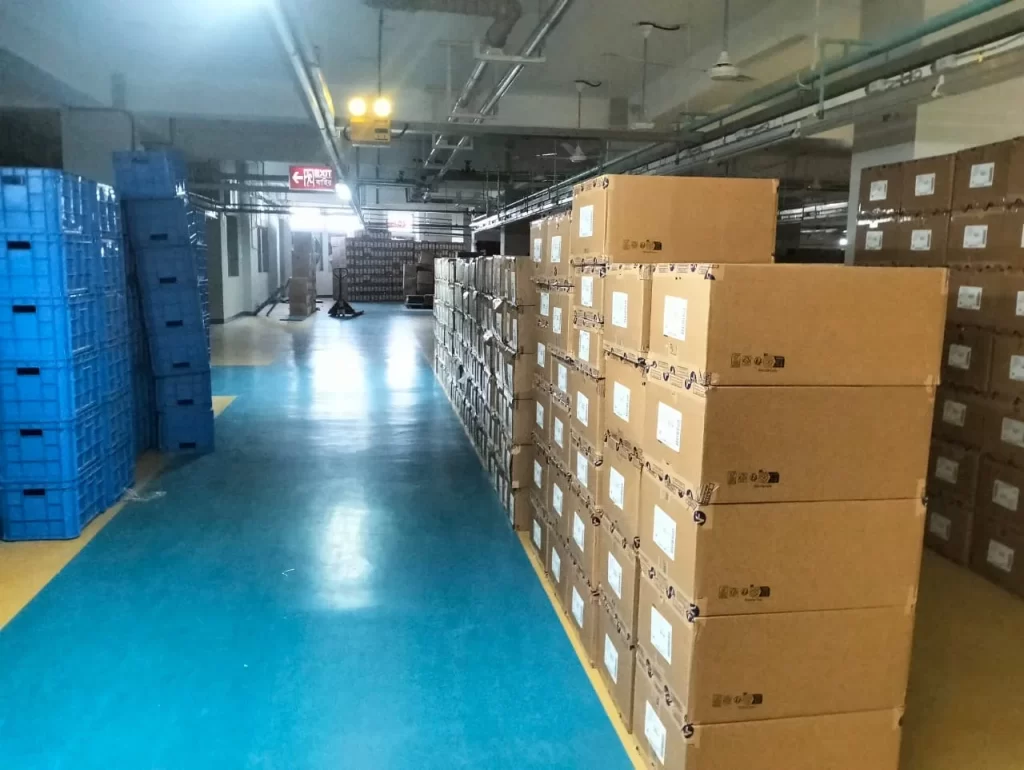
A seamless blue epoxy floor with yellow aisle marking in a factory warehouse in Bangladesh. See more on our projects page.
Frequently Asked Questions
What is the best floor coating for a warehouse in Bangladesh?
For most dry warehouses, a self-leveling epoxy such as Dupoxy SL with line marking is the best value. For cold stores, food warehouses or wet loading areas, PU concrete (Ducrete MF) is more durable.
Can forklifts drive on an epoxy floor?
Yes, once fully cured. A self-leveling epoxy of suitable thickness handles forklift and pallet-truck traffic; thin paint coatings do not.
How long before a warehouse can be used again?
Foot traffic is usually possible within about a day, but heavy forklift traffic should wait until the coating is fully cured – around 7 days for Dupoxy SL at 25°C.
Do you do line marking and floor repairs?
Yes. We repair cracks and joints before coating and add walkway, aisle and safety line marking as part of the job.
Planning a cold room or freezer store? Read our guide to cold storage flooring in Bangladesh.
Talk to DPF
DPF manufactures and installs industrial floor coatings for warehouses, factories and logistics facilities in Bangladesh and Malaysia. Contact us for a free site inspection and quotation, or explore the industries we serve.