Quick answer: For cold rooms, freezers and chilled food stores in Bangladesh, the most reliable floor is a PU concrete floor such as Ducrete MF. It stays bonded at low temperatures (down to about -15°C for a 4 mm system), handles thermal shock from washdown, and gives a seamless, hygienic, slip-resistant surface. Standard epoxy is better kept for dry, ambient-temperature areas.
Last updated: November 2026 · By Ducon Polymer Flooring (DPF)
Bangladesh’s cold chain is growing fast – frozen fish and shrimp, dairy, ice cream, meat, vegetables, pharmaceuticals and vaccines all depend on cold rooms and freezer warehouses. Yet the floor is often the weakest part of these buildings. This guide explains why cold store floors fail, which flooring system works, and how to plan an installation.
Why Cold Store Floors Fail
- Thermal shock: floors move between freezing temperatures and hot-water or steam cleaning. Rigid coatings crack or lose bond when the slab expands and contracts.
- Moisture and condensation: warm, humid air entering through doors condenses on cold surfaces. Coatings applied on damp concrete blister and peel.
- Forklift and pallet traffic: heavy, constant loads at door thresholds and loading bays wear out weak surfaces quickly.
- Hygiene: cracks and joints trap water, ice, blood and food residue, creating bacteria and odour problems that auditors notice.
- Slips: ice, water and fat make smooth floors dangerous for workers.
Best Flooring for Cold Rooms: PU Concrete
PU concrete (polyurethane-cement) combines a polyurethane resin with a cement-based aggregate. It is tougher and more flexible than standard epoxy, so it tolerates temperature changes far better.
DPF’s Ducrete MF is a 4-component PU concrete hybrid floor coating. Its key properties for cold stores:
- Service temperature of about -5°C to +70°C at 3 mm and -15°C to +70°C at 4 mm; up to +90°C in the 5–6 mm broadcast system
- High thermal shock resistance for daily hot-water washdown
- Compressive strength above 50 N/mm² for forklift and pallet traffic
- Seamless, low-absorption surface (water absorption below 0.01 kg/m²h0.5) that is easy to clean
- Solvent-free, odourless and non-tainting to food
- Textured, slip-resistant finish
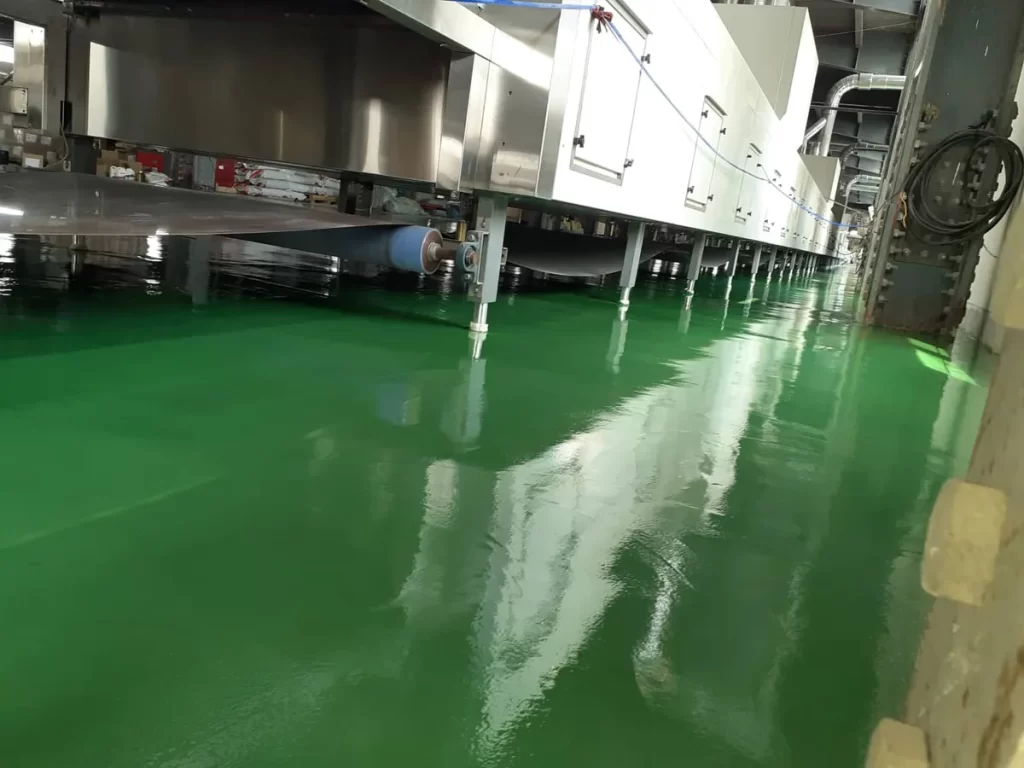
Ducrete MF PU concrete under a food production line in Bangladesh.
Where Epoxy Still Makes Sense
Dupoxy SL self-leveling epoxy is an excellent floor for dry, ambient areas around the cold store: packing halls, dispatch offices, laboratories and corridors. It gives a smooth, glossy and easy-to-clean finish at a competitive price. Inside freezer rooms and areas with hot washdown, however, PU concrete is the safer choice. Read more in PU vs epoxy flooring.
Recommended System by Zone
| Zone | Recommended floor |
|---|---|
| Freezer rooms and blast freezers | Ducrete MF PU concrete, 4–6 mm |
| Chiller rooms (0–8°C) | Ducrete MF PU concrete, 3–4 mm |
| Processing areas with hot washdown | Ducrete MF PU concrete, 4–6 mm, with coving to walls |
| Loading docks and anterooms | Ducrete MF PU concrete with line marking |
| Packing halls, labs and offices | Dupoxy SL self-leveling epoxy |
Installation: What Must Be Done Right
- Plan the shutdown. PU concrete must be applied to a slab at normal temperature (application range about 10–30°C). Existing cold rooms need to be emptied and brought up to temperature before work starts.
- Check the slab. The concrete must be sound (minimum C25/30, pull-off strength at least 1.5 N/mm²), dry, and free of ice, oil and old coatings. New slabs should be properly cured.
- Prepare mechanically. We remove laitance and contamination by diamond grinding or shot blasting and cut anchor grooves at edges, doors, drains and columns.
- Apply and detail. After priming, Ducrete MF is laid with a notched trowel and spike roller. Coving at wall junctions and correct falls to drains stop water collecting.
- Cure before cooling. Foot traffic is usually possible after about 12–20 hours and heavy traffic after about 2 days at 23°C. Full chemical resistance takes about 7 days, so plan the cool-down and loading schedule with our team.
How Much Does Cold Storage Flooring Cost?
As a guide, Ducrete MF PU concrete costs about ৳140–180 per sq ft for 3–4 mm including supply and application. Thicker 5–6 mm systems, coving, drains and floor repairs add to the cost. Prices change with raw-material and shipping costs and are confirmed after a free site inspection. See our PU flooring price guide for details.
Frequently Asked Questions
Can epoxy be used in a freezer room?
Standard epoxy is rigid and can crack or lose bond under freezing temperatures and thermal shock. PU concrete such as Ducrete MF is designed for these conditions and is the safer choice.
Can you install a new floor without demolishing the old one?
Often yes. If the existing slab is sound, we grind or shot-blast it, repair cracks and joints, and lay PU concrete on top. Badly damaged or contaminated areas may need local replacement first.
How long will the cold store be out of use?
It depends on the area and the warm-up time, but small rooms can often be completed in a few days. We plan the work around your stock movement and cure times.
Is Ducrete MF suitable for food plants?
Yes. It is solvent-free, odourless and non-tainting, and its seamless surface supports HACCP-based hygiene programmes. See our guide to food grade PU flooring.
Get a Free Site Inspection
DPF manufactures Ducrete MF and Dupoxy SL at its own plant in Gazipur and installs them with its own team across Bangladesh. Call 01711-037659, email info@duconasia.com or use our contact form. See real floors on our projects page.